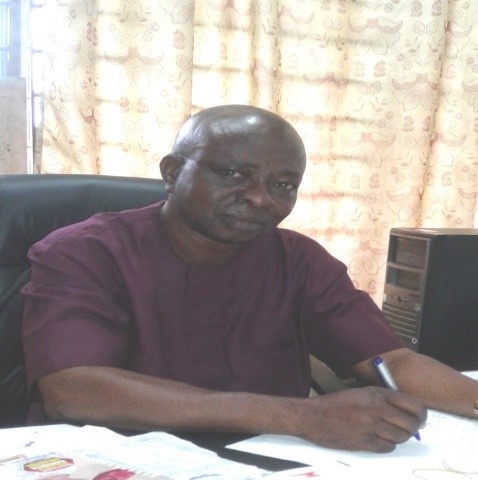
WELCOME MESSAGE BY THE HEAD OF DEPARTMENT
I welcome you to the Department of Science and Technology Education (STE). The Department came to existence after the Governing Council of the Obafemi Awolowo University approved the restructuring of the Faculty of Education on 14th March, 2014. This led to the creation of the Department of Science and Technology Education from the old Department of Special Education and Curriculum Studies that has been in existence since October, 1976 that was put in place by the Provisional Council of the University of Ife (now Obafemi Awolowo University) with the approval of the creation of a Faculty of Education in October, 1967 with only four departments, namely, Department of Education, Department of Adult Education, Institute of Education, and School of General Studies.
The 1976 creation of the “Educational Technology (now Educational Technology and Library Studies), Educational Foundations and Counselling (which has not changed) to, Continuing Education (now Adult education and Lifelong Learning), Institute of Education (which has not changed), Physical and health Education (which has also changed) to Department of Kinesiology, Health Education and Recreation and Special Education and Curriculum Studies( which is now spilt into Science and Technology Education and Arts and Social Science Education).
The B.Sc.Ed. (Biology, Chemistry, Physics, and Mathematics) programmes, which are located in the Department, are designed to provide academic and professional training for teachers in the nation’s secondary schools. The programmes are structured to produce the right calibre of dedicated professional science teachers in both quality and quantity to meet the national curriculum objectives of science education at the secondary school level. Accordingly, students in the Department undergo in-depth courses in both physical (Mathematics, Chemistry and Physics) and Biological (Botany and Zoology) sciences in the Faculties of Science and Education where they acquire sound and relevant concepts, knowledge, skills and attitudes pertinent to the needs of a changing society.
The pedagogical components of the programme are offered in the Faculty of Education which also organises twelve-weeks (six weeks in the second year and another six weeks in the third year) of compulsory and supervised practice teaching exercise coordinated by the Department. Consequently, at the end of the minimum four-year programme (three years minimum for Nigerian Certificate of Education (NCE) graduates from affiliated Colleges of Education), graduates of the Department are deemed to be both professionally and academically prepared to:
(i) Teach Biology, Chemistry, Physics and Mathematics at both the junior and senior secondary school levels and at the non-degree teacher training colleges;
(ii) Inculcate in the students the spirit and attitude of inquiry, creativity and the ability to think critically, rationally and effectively in solving personal and professional problems.
Philosophy and Objectives of the Department
In line with the pursuance of the overall aim and objectives of the Faculty of Education, the Department of Science and Technology Education seeks with vigour the aim of training science and Mathematics teachers both at undergraduate and postgraduate levels. The aim of the Faculty of Education, Obafemi Awolowo University, Ile-Ife, is to produce teachers and educators with a solid background in the concept, knowledge and understanding of education and teaching, as well as the application and use of such knowledge for general improvement of themselves and mankind.
Consequently, the Department of Science and Technology Education aims at contributing to the achievement of the goals of the Faculty by training students at both the undergraduate and postgraduate levels. The Department has among its goals, ensuring educational evaluation, carrying out research and dissemination of research findings in the area of curriculum at all levels and on issues affecting classroom teaching and testing. Undergraduate students are equipped with the necessary knowledge, skills and attitudes for delivering effective lessons in the secondary school. The postgraduate programmes are aimed at producing competent educators in all disciplines as well as equipping students with the knowledge and skills necessary for conducting and evaluating research studies in the fields of curriculum and instruction. As a result, the Department teaches courses in curriculum and instruction to science undergraduate students in the Faculty and to postgraduate students who desire to deepen their knowledge of curriculum and instruction.
Generally, courses offered in curriculum cover issues of theory, design, practice, evaluation, and revision while those in instruction focus science subjects listed in the National Policy on Education and taught in Nigerian secondary schools. Courses offered in the Department are expected to provide adequate professional and academic training for teachers in the nation’s secondary and tertiary schools and personnel for other education oriented sectors.
Academic Staff
i. Professor E. F. Bamidele – Head of Department
ii. Professor M. A. Adeleke
iii. Dr. T. A. Adebisi- Senior Lecturer
iv. Dr. A. O. Kareem- Senior Lecturer
v. Dr. A. A. Adetunji- Lecturer I
vi. Dr. F. B. Yoade- Lecturer II
vii. Mr. O. P. Oladipupo Lecturer II
viii. Mr. T. O. Akinbayo Assistant Lecturer
Academic Programmes
(a) Undergraduate level: The Department caters for the science and Mathematics programmes, that is, Education Agricultural Science, Education Biology, Education Chemistry, Education Computer, Education Home Economics, Education Physics, Education Mathematics, and Technical Education . The core and elective courses are offered to students of the programme within and outside the Department. All curriculum and instruction-related courses are offered in the Department to this set of students while there are compulsory curriculum and instruction-related courses for science oriented Parts II and III students in the Faculty.
(b) Postgraduate level: At the postgraduate level, the M. Ed, M. Sc.Ed, M. Phil and Ph. D. degree programmes are offered in the Department. While the M. Ed and Ph. D. programmes are only in Curriculum Studies, the M. Sc.Ed programme is both in Curriculum Studies and the various disciplines covering the science subjects approved by Government for Nigerian secondary schools. Depending on the programme pursued, core courses are offered to students within and outside the Faculty.
Specifically, courses taught at the undergraduate level by the Department are as follows:
Course Code Course Title Units
STE 301 Curriculum Development 2
STE 305 Curriculum Development in
Environmental Education 2
STE 320 Introduction to Long Essay 2
STE 300 Biology Teaching Methods 2
STE 302 Chemistry Teaching Methods 2
STE 303 Curriculum for the Exceptional Child 2
STE 304 Mathematics Teaching Methods 2
STE 306 Physics Teaching Methods 2
STE 308 Mathematics/Integrated Science
Teaching Methods 2
STE 401 Long Essay 2
STE 402 Education and the Human Environment 2
STE 403 Classroom Testing 2
In addition to teaching courses in curriculum and instruction to all students in the Faculty, the Department offer advisory services to students offering Mathematics and science courses such as Agricultural Science, Biology, Chemistry, Computer, Home Economics and Physics. This is done to ensure closer contact with students based on homogeneity of subjects as well as help these students with administrative issues such as registration of courses, collation of results and computation of grades via the staff advisory system. The students in the Department obtain a B.Sc. Ed degree with specialization in their respective subjects. Consequently, the following programs are housed in the Department:
i. B.Sc. Education/Biology
ii. B.Sc. Education/Chemistry
iii. B.Sc. Education/Physics
iv. B.Sc. Education/Mathematics and
v. B.Sc.Education/Agricultural Science
vi. B.Sc.Education/Computer Science
vii. B.Sc.Education/Home Economics and
viii. B.Sc.Education/ Technical Education
The Department, in collaboration with the Department of Arts and Social Science Education also houses the teaching practice programme for all Parts II and III students in the Faculty as well as M. Ed students who do not have a degree in Education.
Postgraduate programme
The courses taught in the Department at the postgraduate level are as follows:
STE 801 Theory and Practice in Curriculum
Development 3
STE 802 Organization and Supervision of
Instruction 3
STE 803 Educational Statistics I 3
STE 804 Techniques in Tests and Measurement 3
STE 805 Introduction to Educational Research
Methods 3
STE 806 Principles and Learning and Instruction 3
STE 808 Programmed Learning in Secondary School
Curriculum 3
STE 809 Curriculum and Instruction in Secondary
School Science 3
STE 810 Diagnostic and Remedial Teaching of
Mathematics 3
STE 811 Curriculum and Instruction in Secondary
School Science 3
STE 814 Curriculum Building in Science Education
STE 819 Principles and Problems of Curriculum
Evaluation 3
STE 820 Advanced Learning Theories 3
STE 901 Curriculum Innovation and Improvements 3
STE 902 Principles and Problems of Curriculum
Evaluation 3
STE 903 Educational Research Methods 3
STE 904 University Teaching Methods 3
STE 905 Educational Statistics II 3
STE 907 Statistics and Research in Education 3
STE 627 Elementary School Curriculum 3
STE 629 Secondary School Curriculum 3
STE 633 Principles and Problems of Instruction in
Higher Education 3
These courses are taken by postgraduate students leading to nine different degrees, namely,
1. M. Ed (Curriculum Studies)
2. M. Sc. Ed (Curriculum Studies)
3. M. Sc Ed (Mathematics)
4. M.Sc. Ed (Chemistry)
M. Sc. Ed (Physics)
6. M. Sc. Ed (Botany)
7. M. Sc. Ed (Zoology)
8. M. Phil (Science Education)
9. Ph. D Education (Curriculum Studies)
Students Enrolment and Development
a. Undergraduate level: Undergraduate students in the Faculty do not belong to particular Departments in the conventional sense but only for administrative and advisory purposes. Hence, the B. Sc. degrees in Education for the various programmes housed in the Department are jointly awarded by different Departments. The number of students for which the Department caters in terms of advisory purposes, registration and processing of results varies progressively from year to year.
Notably, two students received UNESCO scholarship to complete their studies in the United States of America.
b. Postgraduate level: The Department has produced many postgraduate students since inception. The number has gradually increased particularly in curriculum and certain subject areas. Presently, the Department has about 70 bonafide postgraduate students at different stages of their programmes. While some of our students’ research studies have been published in reputable journals both within and outside the country, some have received recognition with grants by notable bodies and fellowships.
Departmental Growth
The Department has grown over the years in terms of students enrolment, staff strength and programmes offered. In spite of the various courses already developed, programmes are still being developed to meet the challenges of global societal dynamism. The growth in academic programmes has brought about an increase in student enrolment particularly at the postgraduate level. The recognition of Science as a fundamental aspect of development and the consequent emphasis on its importance, as well as Science/Arts ratio stipulated in the National Policy on Education (2007), have contributed in no small measure to increased undergraduate enrolment. Growth in programmes has equally increased staff strength at different levels spanning professors, readers, senior lecturers, lecturers, assistant lecturers and graduate assistants. A number of the products of the Department who are qualified are appointed as lecturers, which is a strong index of the quality of the programmes offered in the Department and of growth. The increase in students and staff is not limited to numerical growth as both staff and students have availed themselves of various local and international fellowships and grants to develop themselves academically.
Research
The Department continues to place premium on quality research. Individually, members of staff continue to carry out research primarily in the areas of curriculum, learning and instruction in various disciplines of interest. Such research outcomes are published in reputable local and international journals. Several have written or contributed to books that focus issues in curriculum and allied disciplines. In addition, research has been further disseminated in a Departmental book which was published in Ghana. Presently, an editor for books for the tertiary level in the United States of America has commissioned the Department to write a book in curriculum and groundwork has already started. Equally, groundwork has started on the Departmental journal. Members are also involved in writing textbooks for secondary school students in various disciplines.
Also as a means of disseminating research, members of staff participate in both local and international conferences. Some are actually involved in organising seminars and workshops for different educational-focused establishments.
Services to the Community
Members of staff offer their services to the community in different ways. Many participate in the moderation of examination questions and scripts, teaching practice exercise of the University undergraduate and postgraduate programmes offered at Adeyemi College of Education, Ondo and some other universities. Some render different services to other colleges of Education and primary and secondary schools. Some serve as consultants to federal agencies such as the Universal Basic Education Commission (UBEC) and National Agency for Prohibition of Traffic in Persons (NAPTIP). Some are consultants to federal government parastatals and some international organisations. Some serve as Board members of educational institutions and resource persons in various workshops and conferences. Some also serve as editors to Journal both locally and internationally.
In order to impact the community positively and bridge the gap between the town and the gown, members through the ‘Ife School Curriculum Improvement Group’ housed in the Department, go to schools to show practicing teachers who are unable to go out for workshops due to their inability to pay for such workshops, how to teach following best practices by organising sample lessons.
Staff Strength
The academic staff strength of the Department consists of the following 6 members:
Professor – 2
Reader Nil
Senior Lecturers 2
Lecturer I – 1
Lecturer II – 2
Assistant Lecturer – 1
Graduate Assistant- –
The Non -academic staff strength of the Department consists of the following members:
Facilities
The Department has offices that are basically well-furnished and adequate for research all other things being equal. The offices have internet facilities though the Department also furnish every member with computers or laptops. The purchase of a photocopying machine has contributed to speedy processing of papers within and outside the Department. In addition, the Department has a resource and demonstration room in honour of the Late Dr (Mrs) O. O. Dibu-Ojerinde, a former Acting Head of Department who was passionate about the teaching profession. Some computers and printers were donated to the Department by her family. There is also a science laboratory, for science students to be taught methods of teaching science. A generating set was donated to the Department by undergraduate students during a Teaching methodology Class. This has helped to minimise, not eradicate, the problems faced by the challenge of incessant power outage on campus. Also, different teaching and learning resources are consistently being donated by students to enhance teaching and learning.
Once again you are welcome to the Department of Science and Technology Education